Friday, 7 February 2014

CHAPTER 8

ACCESSING ORGANIZATIONAL INFORMATION - DATA WAREHOUSE
 
In this chapter, we learned about :
 
  • Descibe the roles and purposes of data warehouses and data marts in an organization
  • Compare the multidimensional nature of data warehouses (and data marts), with the two-dimensional nature of databases
  • Identify the importance of ensuring the cleanliness of information throughout an organization
  • Explain the relationship between business intelligence and a data warehouse
 
HISTORY OF DATA WAREHOUSING
 
  • Data warehouses extend the transformation of data into information
  • In the 1990's executives became less concerned with the day-to-day business operations and more concerned with overall business functions 
  • The data warehouse provided the ability to support decision making without disrupting the day-to-day operations
 
DATA WAREHOUSES FUNDAMENTALS
 
  • Data warehouse - A logical collection of information - gathered from many different operational databases - that supports business analysis activities and decision-making tasks
  • The primary purpose of a data warehouse is to aggregate information throughout an organization into a single repository for decision-making purposes
  • Extraction, transformation, and loading (ETL) - A process that extracts information from internal and external databases, transforms the information using a common set of enterprise definitions, and loads the information into a data warehouse
  • The ETL process gathers data from the internal and external databases and passes it to the data warehouse
  • The ETL process also gathers data from the data warehouse and passes it to the data marts
  • Data mart - Contains a subset of data warehouse information
 
MULTIDIMENSIONAL ANALYSIS AND DATA MINING
 
  • Databases contain information in a series of two-dimensional tables
  • In a data warehouse and data mart, information is multidimensional, it contains layers of columns and rows
- Dimension - A particular attribute of information
  • Each layer in a data warehouse or data mart represents information according to an additional dimension
  • Dimensions could include such things as :
- Products
- Promotions
- Stores
- Category
- Region
- Stock price
- Date
- Time
- Weather
  • Cube - Common term for the representation of multidimensional information
 
 
- Users can slice and dice the cube to drill down into the information
- Cube A represents store information (the layers), product information (the rows), and promotion information (the columns)
- Cube B represents a slice of information displaying promotion II for products at all stores
- Cube C represents a slice of information displaying promotion III for product B at store 2
  • Data mining - The process of analyzing data to extract information not offered by the raw data alone
  • To perform data mining users need data mining tools
- Data mining tool - Uses a variety of techniques to find patterns and relationships in large volumes of information and infers ruler that predict future behavior and guide decision making
  • Data mining can begin at a summary information level (course granularity) and progress through increasing levels of detail (drilling down), or the reverse (drilling up)
  • Data-mining tools include query tools, reporting tools, multidimensional analysis tools, statistical tools, and intelligent agents
 
INFORMATION CLEANSING OR SCRUBBING
 
  • An organization must maintain high-quality data in the data warehouse
  • Information cleansing or scrubbing -  A process that weeds out and fixes or discards inconsistent, incorrect, or incomplete information
  • Contact information in an operational system


  • Standardizing customer name from Operational Systems
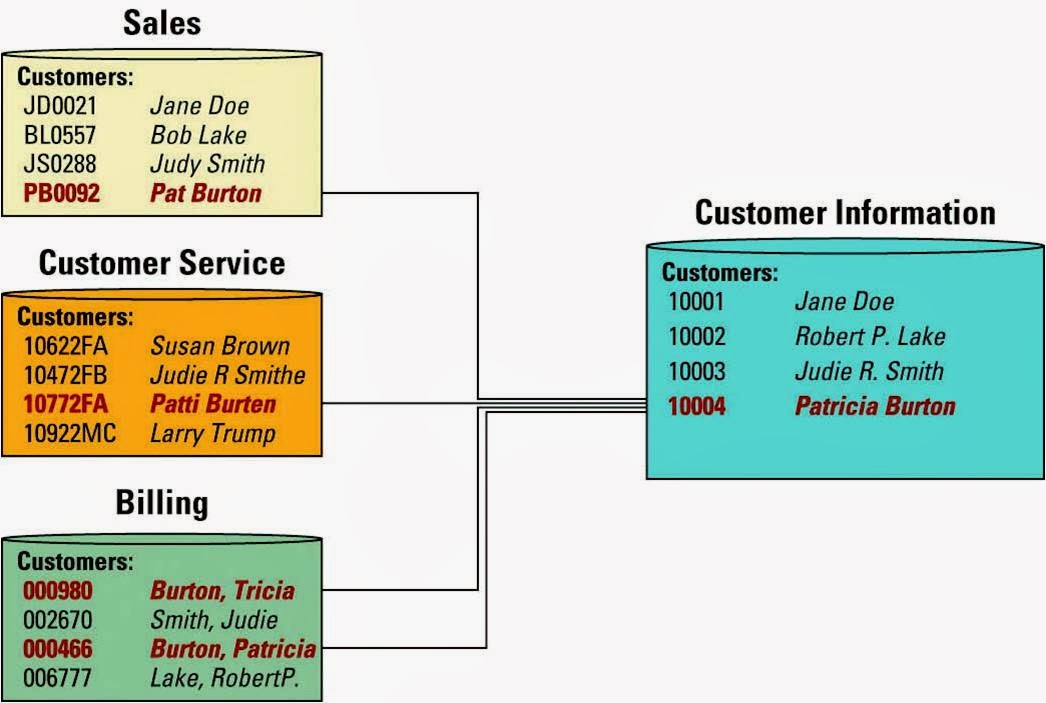
 
 
  •  Information cleansing activities
 
 
- Information cleansing allows an organization to fix these types of inconsistencies and cleans the data in the data warehouse

  • Accurate and complete information
 
 
BUSINESS INTELLIGENCE

  • Business intelligence - Information that people use to support their decision-making efforts
  • Principle BI enablers include :
 - Technology
- People
- Culture

Wednesday, 5 February 2014

CHAPTER 7

STORING ORGANIZATIONAL INFORMATION - DATABASES

In this chapter, we learned about :

  • Define the fundamental concepts of the relational database model
  • Evaluate the advantages of the relational database model
  • Compare relational integrity constraints and business-critical integrity constraints
  • Describe the benefits of a data driven Web site
  • Describe the two primary methods for integrating information across multiple databases

RELATIONAL DATABASE FUNDAMENTALS

  • Information is everywhere in an organization
  • Information is stored in databases
- Database : maintains information about various types of objects (inventory), events (transactions), people (employees),  and places (warehouses)
  • Database models include :
- Hierarchical database model : information is organized into a tree-like structure (using parent/child relationships) in such a way that it cannot have too many relationships


- Network database model : a flexible way of representing objects and their relationships


- Relational database model : stores information in the form of logically related two-dimensional tables


ENTITIES AND ATTRIBUTES


  • Entity : a person, place, thing, transaction, or event about which information is stored
- the rows in each table contain the entities
  • Attributes (fields, columns) : characteristics or properties of an entity class
- the columns in each table contain the attributes

KEYS AND RELATIONSHIPS

  • Primary keys and foreign keys identify the various entity classes (tables) in the database
- Primary key : a field (or group of fields) that uniquely identifies a given entity in a table
- Foreign key : a primary key of one table that appears and attribute in another table and acts to provide a logical relationship among the two tables
  • Potential relational database for Coca-Cola


RELATIONAL DATABASE ADVANTAGES


  • Database advantages from a business perspective include :
- increased flexibility
- increased scalability and performance
- reduced information redundancy
 - increased information integrity (quality)
- increased information security

INCREASED FLEXIBILITY

  • A well-designed database should :
- handle changes quickly and easily
- provide users with different views
- have only one physical view
  • physical view : deals with the physical storage of information on a storage device. For example, hard disk
- have multiple logical views
  • logical view : focuses on how users logically access information
- example : a mail-order bus - two people view different format (logical views) but same physical view

INCREASED SCALABILITY AND PERFORMANCE

  • A database must scale to meet increased demand, while maintaining acceptable performance level
- scalability : refers to how well a system can adapt to increased demands
- performance : measures how quickly a system performs a certain process or transaction

REDUCED INFORMATION REDUNDANCY

  • Databases reduce information redundancy
- redundancy : the duplication of information or storing the same information in multiple places
  • Inconsistency is one of the primary problems with redundant information difficult to decide which is most current and most accurate

INCREASED INFORMATION INTEGRITY (QUALITY)

  • Information integrity : measures the quality of information
  • Integrity constraint : rules that help ensure the quality of information
- relational integrity constraint : rule that enforces basic and fundamental information based constraints
- Example : users cannot create an order for a nonexistent customer, provide a markup percentage that was negative
- business-critical integrity constraint : rule that enforce business rules vital to an organization's success and often require more insight and knowledge than relational integrity constraints
- Example : product returns are not accepted for fresh product 15 days after purchase

INCREASED INFORMATION SECURITY

  • Information is an organizational asset and must be protected
  • Databases offer several security features including :
- password : provide authentication of the user
- access level : determines who has access to the different types of information
- access control : determines types of user access, such as read-only access

DATABASE MANAGEMENT SYSTEMS

  • Database Management Systems (DBMS) : software through which users and application programs interact with a database


DATA-DRIVEN WEB SITES


  • Data-driven web sites : an interactive Web site kept constantly updated and relevant to the needs of its customers through the use of a database


DATA-DRIVEN WEB SITE BUSINESS ADVANTAGES


  • Development
  • Content management
  • Future expandability
  • Minimizing human error
  • Cutting production and update costs
  • More efficient
  • Improved stability

DATA-DRIVEN BUSINESS INTELLIGENCE
  • BI in a data-driven Web site


INTEGRATING INFORMATION AMONG MULTIPLE DATABASES


  • Integration : allows separate systems to communicate directly with each other
- forward integration : takes information entered into a given system and sends it automatically downstream systems and processes
- backward integration : takes information entered into a given system and sends it automatically to all upstream systems and processes
  • Forward integration 


  • Backward integration


  • Building a central repository specifically for integrated information

  • Without integration, an organization will :
    - spend considerable time entering the same info in multiple system
    - suffer from the low quality and inconsistency typically embedded in redundant information

Monday, 27 January 2014

CHAPTER 6

VALUING ORGANIZATIONAL INFORMATION

In this chapter, we learned about :

  • Describe the broad levels, formats, and granularities of information
  • Differentiate between transactional and analytical information
  • List, describe, and provide an example of each of the five characteristics of high quality information
  • Assess the impact of low quality information on an organization and the benefits of high quality information on an organization

Organizational Information

* Information is everywhere in a organization

* Employees must be able to obtain and analyze the many different levels, formats, and granularities of organizational information to make decisions

* Successfully collecting, compiling, sorting, and analyzing information can provide tremendous insight into how an organization is performing

* Levels, formats, and granularities of organizational information


The Value of Transactional and Analytical Information

* Transactional information verses analytical information


* Transactional information - encompasses of all the information contained within a single business process or unit of work, and its primary purpose is to support the performing of daily operational tasks

* Analytical information - encompasses all organizational information, and its primary purpose is to support the performing of managerial information task

The Value of Timely Information

* Timeliness is an aspect of information that depends on the situation

- Real-time information ~ immediate, up-to-date information
- Real-time system ~ provides real-time information in response to query requests

The Value of Quality Information

* Business decisions are only as good as the quality of the information used to make the decisions

* You never want to find yourself using technology to help you make a bad decision faster

* Characteristics of high-quality information include :

- Accuracy ~ are all the values correct? For example, is the name spelled correctly? Is the dollar amount recorded properly?
- Completeness ~ are any of the values missing? For example, is the address complete including street, city, state, and zip code?
- Consistency ~ is aggregate or summary information in agreement with detailed information? For example, do all total fields equal the true total of the individual fields
- Uniqueness ~ is each transaction, entity, and event represented only once in the information? For example, are there any duplicate customers?
- Timeliness ~ is the information current with respect to the business requirements? For example, is information updated weekly, daily, or hourly?

* Low quality information example


Understanding the Cost of Poor Information

* The four primary sources of low quality information include :

- Online customers intentionally enter inaccurate information to protect their privacy
- Information from different systems have different entry standards and formats
- Call center operators enter ebbreviated or errorneous information of accident or to save time
- Third party and external information contains inconsistencies, inaccuracies, and errors

* Potential business effects resulting from low quality information include :

- Inability to accurately track customers
- Difficulty identifying valuable customers
- Inability to identify selling opportunities
- Marketing to nonexistent customers
- Difficulty tracking revenue due to inaccurate invoices
- Inability to build strong customer relationships

Understand the Benefits of Good Information

* High quality information can significantly improve the chances of making a good decision

* Good conditions can directly impact an organization's bottom line

CHAPTER 5

ORGANIZATIONAL STRUCTURES THAT SUPPORT STRATEGIC INITIATIVES

In this chapter, we learned about :

  • Compare the responsibilities of a chief information officer (CIO), chief technology officer (CTO), chief privacy officer (CPO), chief security officer (CSO), and chief knowledge officer (CKO)
  • Explain the gap between IT people and business people and the primary reason this gap exists
  • Define the relationship between information security and ethics

Organizational Structure

* Organizational employees must work closely together to develop strategic initiatives that create competitive advantages

* Ethics and security are two fundamental building blocks that organizations must base their businesses upon


IT Roles and Responsibilities

* Information technology is a relatively new functional area, having only been around formally for around 40 years

* Recent IT-strategic positions :

- Chief Information Officer (CIO)
- Chief Technology Officer (CTO)
- Chief Security Officer (CSO)
- Chief Privacy Officer (CPO)
- Chief Knowledge Officer (CKO)

* Chief Information Officer (CIO) - oversees all uses of IT and ensures strategic alignment of IT with business goals and objectives

* Broad CIO functions include :

- Manager ~ ensuring the delivery of all IT project, on time and within budget
- Leader ~ ensuring the strategic vision of IT is in line with the strategic vision of the organization
- Communicator ~ building and maintaining strong executive relationships

* Average CIO compensation by industry


* What concerns CIOs the most


* Chief Technology Officer (CIO) - responsible for ensuring the throughput, speed, accuracy, availability, and reliability of IT

* Chief Security Officer (CSO) - responsible for ensuring the security of IT systems

* Chief Privacy Officer - responsible for ensuring the ethical and legal use of information

* Chief Knowledge Officer - responsible for collecting, maintaining, and distributing the organization's knowledge

* Skills pivotal for success in executive IT roles


The Gap Between Business Personnel and IT Personnel

* Business personnel possess expertise in functional areas such as marketing, accounting, and sales

* IT personnel have the technological expertise

* This typically causes a communications gap between the business personnel and IT personnel

Improving Communications

* Business personnel must seek to increase their understanding of IT

* IT personnel must seek to increase their understanding of the business

* It is the responsibility of the CIO to ensure effective communication between business personnel and IT personnel

Organizational Fundamentals - Ethics and Security

* Ethics and security are two fundamental building blocks that organizations must base their businesses on to be successful

* In recent years, such event as the Enron and Martha Stewart, along with 9/11 have shed new light on the meaning of ethics and security

Ethics

* Ethics - the principles and standards that guide our behaviour toward other people

* Privacy is a major ethical issue

- Privacy ~ the right to be left alone when you want to be, to have control over your own personal possessions, and not to be observed without your consent

* Issues affected by technologies advances

- Intellectual property ~ intangible creative work that is embodied in physical form
- Copyright ~ the legal protection afforded an expression of an idea, such as a song, video game, and some types proprietary documents
- Fair use doctrine ~ in certain situations, it is legal to use copyrighted material
- Pirated software ~ the unauthorized use, duplication, or sale of copyrighted software
Counterfeit software ~ software that is manufactured to look like the real thing and sold as such

* One of the main ingredients in trust is privacy

* Primary reasons privacy issues lost trust for e-business


Security

* Organizational information is intellectual capital

- It must be protected

* Information security ~ the protection of information from accidental or intentional misuse by persons inside or outside an organization

* E-business automatically create tremendous information security risks for oganizations


Tuesday, 7 January 2014

CASE STUDY

PAST YEAR OCTOBER 2009


Question 1

Identify five (5) of competitive advantages used by AirAsia (5 marks)

Five (5) competitve advantages used by AirAsia are :
  1. AirAsia launching new routes from its hub in Kuala Lumpur International Airport at breakneck speed
  2. AirAsia operates scheduled domestic and international flights and is Asia's largest low fare, no frills airline
  3. AirAsia pioneered low cost travelling in Asia
  4. It is also the first airline in the region to implement fully ticketless travel and unassigned seats
  5. AirAsia operates with the world's lowest unit cost of US$0.023/ASK (available seat per kilometer) and a passanger break-even load factor of 52%

Question 2

Which of the Porter's generic strategies were applied by AirAsia in the case study and explain with example
(6 marks)

The Porter's generic strategies were applied by AirAsia in the case study are :
Cost Leadership
- AirAsia becoming a low-cost producer in the industry allows the company to lower the prices to customers.
- For example, AirAsia operates with the world's lowest unit cost of US$0.023?ASK (available seat per kilometer)

Differentiation
- AirAsia create competitive advantage by distinguish their products on one or more features important to their customers
- For example, in the five-year plan, AirAsia will strengthen and enhance its route network by connecting all the existing cities in the region and expanding further into Indochina, Indonesia, Southern China (Kun Ming, Xiamen, Shenzen) and India

Focus strategy
- AirAsia has a target to a niche market
- For example, the airline will focus on developing its hubs in Bangkok and Jakarta through its sister companies, Thai AirAsia and Indonesia AirAsia since with the five-year plan, AirAsia will strengthen and enhance its route network.

Question 3

Based on Porter's Five Force Model, analyze AirAsia's buyer power and supplier power (9 marks)

Buyer power
- AirAsia assessed by analyzing the ability to directly impact the price they are willing to pay for an item
- It is high when buyers have many choices of whom to buy and it is low when their choices are few
- For example, AirAsia operates with the world's lowest unit cost of US$0.023/ASK (available seat per kilometer) and a passenger break-even load factor of 52%

Supplier power
- AirAsia assessed by the suppliers' ability to directly impact the price they are charging for supplies
- It is high when buyers have few choices of whom to buy from and it is low when their choices are many
- For example, AirAsia is currently the main customer of the Airbus A320 the company has placed an order 0f 175 units of the same plane to service its routes and it is also enhance its route network by connecting all the existing cities in the region and expanding further into Indo China, Indonesia, Southern China (Kun Ming, Xiamen, Shenzen) and India

Friday, 3 January 2014

CHAPTER 4

MEASURING THE SUCCESS of STRATEGIC INITIATIVES


In this chapter, we learned about :

  • Compare efficiency IT metrics and effectiveness metrics
  • List and describe five common types of efficiency IT metrics
  • List and describe four types of effectiveness of IT metrics
  • Explain customer metrics and their importance to an organization


MEASUREMENT INFORMATION TECHNOLOGY'S SUCCESS

  • Key performance indicator - measures that are tied to business drivers
  • Metrics are detailed measures that feed KPIs
  • Performance metrics fall into the nebulous area of business intelligence that is neither technology, nor business centered, but requires input from both IT and business professionals


EFFICIENCY and EFFECTIVENESS

  • Efficiency focuses on the extent to which an organization is using its resources in an optimal way, "Doing things right"
  • Effectiveness focuses on how well an organization is achieving its goal and objectives, "Doing the right things"
  • Efficiency IT metric - measures the performance of the IT system itself  including throughput, speed, and availability
  • Effectiveness IT metric - measures the impact IT has on business processes and activities including customer satisfaction conversion rates, and sell-through increases


BENCHMARKING - BASELINING METRICS


  • Regardless of what it is measured,  how it is measured, and whether it is for the sake of efficiency or effectiveness, there must be benchmark - baseline values the system seeks to attain
  • Benchmarking - a process of continuously measuring system results, comparing those results to optimal system performance (benchmark values), and identifying steps and procedures to improve system performance
  • E-government benchmark


THE INTERRELATIONSHIP of EFFICIENCY and EFFECTIVENESS IT METRICS


  • Efficiency metrics monitor technology
  • Efficiency metric are easier to measure monitor than effectiveness metrics
  • Efficiency IT metrics focus on technology and include :

- Throughput ~ the amount of information that can travel through a system at any point
- Transaction speed ~ the amount of time a system takes to perform a transaction
- System availability ~ the number of hours a system is available for users
- Information accuracy ~ the extent to which a system generates the correct results when executing the same transaction numerous time
- Web traffic ~ includes a host of benchmark such as the number of page views, the number of unique visitors, and the average time spent viewing a Web page
- Response time ~ the time it takes to respond to user interactions such as a mouse click
Effectiveness IT metrics focus on an organization's goals, strategies, and objectives and include :

- Usability ~ the ease with which people perform transactions and/or information. A popular usability metric on the Internet is the degrees of freedom, which measures the number of clicks required to find desired information
- Customer satisfaction ~ measured by such benchmarks as satisfaction surveys, percentage of existing customers retained, and increases in revenue dollars per customer
- Conversion rates ~ the number of customers an organization "touches" for the first time and persuades to purchase its products or services. This is a popular metric for evaluating the effectiveness of banner, pop-up, and pop-under ads on the Internet
- Financial ~ such as return on investment (the earning power of an organization's assets), cost-benefit analysis (the comparison of projected revenues and costs including development, maintenance, fixed, and variable), and break-even analysis the point at which constant revenues equal ongoing costs)
  • Security is an issue for any organization offering products or services over the Internet
  • It is inefficient for an organization to implement Internet security, since its slows down processing
  • However, to be effective it must implement Internet security
  • Secure Internet connections must offer encryption and Secure Sockets Layers (SSL denoted by the lock symbol in the lower right corner of a browser)
  • Interrelationships between efficiency and effectiveness


METRIC for STRATEGIC INITIATIVES


  • Metrics for measuring and managing strategic initiatives include :
  • Web site metrics
  • Supply chain management (SCM) metrics
  • Customer relationship management (CRM) metrics
  • Business process reengineering (BPR) metrics
  • Enterprise resource planning (ERP) metrics


WEB SITE METRICS


  • Web site metrics include :

- Abandoned registrations ~ number of visitors who start the process of completing a registration page and than abandon the activity
- Abandoned shopping carts ~ number of visitors who create a shopping cart and start shopping and then abandon the activity before paying for the merchandise
- Click-through ~ count of the number of people who visit a site, click on an ad, and are taken to the side of the advertiser
- Conversion rate ~ percentage of potential customers who visit a site and actually buy something
- Cost-per-thousand (CPM) ~ sales dollars generated per dollar of advertising. This is commonly used to make the case for spending money to appear on a search engine
- Page exposures ~ average number of page exposures to an individual visitor
- Total hits ~ number of visits to a Web site, many of which may be by the same visitor
- Unique visitors ~ number of unique visitors to a site in a given time


SUPPLY CHAIN MANAGEMENT METRICS

  • Back order - an unfilled customer order. A back order is demand (immediate or past due) against an item whose current stock level is insufficient to satisfy demand
  • Customer order promised cycle time - the anticipated or agreed upon cycle time of a purchase order It is a gap between the purchase order creation date and the requested delivery date
  • Customer order actual cycle time - the average time it takes to actually fill a customer's purchase order. This measure can be viewed on an order or an order line level
  • Inventory replenishment cycle time - measure of the manufacturing cycle time plus the time included to deploy the product to the appropriate distribution center
  • Inventory turns (inventory turnover) - the number of that a company's inventory cycles or tuns over per year. It i one of the most commonly used supply chain metrics


CUSTOMER RELATIONSHIP MANAGEMENT METRICS


  • Customer relationship management metrics measure user satisfaction and interaction and include :

Sales metrics
* number of prospective customers
* number of new customers
* number of retained customers
* number of open leads
* number of sales calls
* number of sales calls per lead
* amount of new revenue
* amount of recurring revenue
* number of proposals given

Service metrics
* cases closed same day
* number of cases handled by agent
* number of service calls
* average number of service requests by type
* average time to resolution
* average number of service calls per day
* percentage compliance with service-level agreement
* percentage of service renewals
* customer satisfaction level

Marketing metrics
* number of marketing campaigns
* new customer retention rate
* number of responses by marketing campaign
* number of purchases by marketing campaign
* revenue generated by marketing campaign
* cost per interaction by marketing campaign
* number of new customers acquired by marketing campaign
* customer retention rate
* number of new leads by product


 BPR and ERP METRICS

The balanced scorecard enables organizations to measure and manage strategic initiatives